
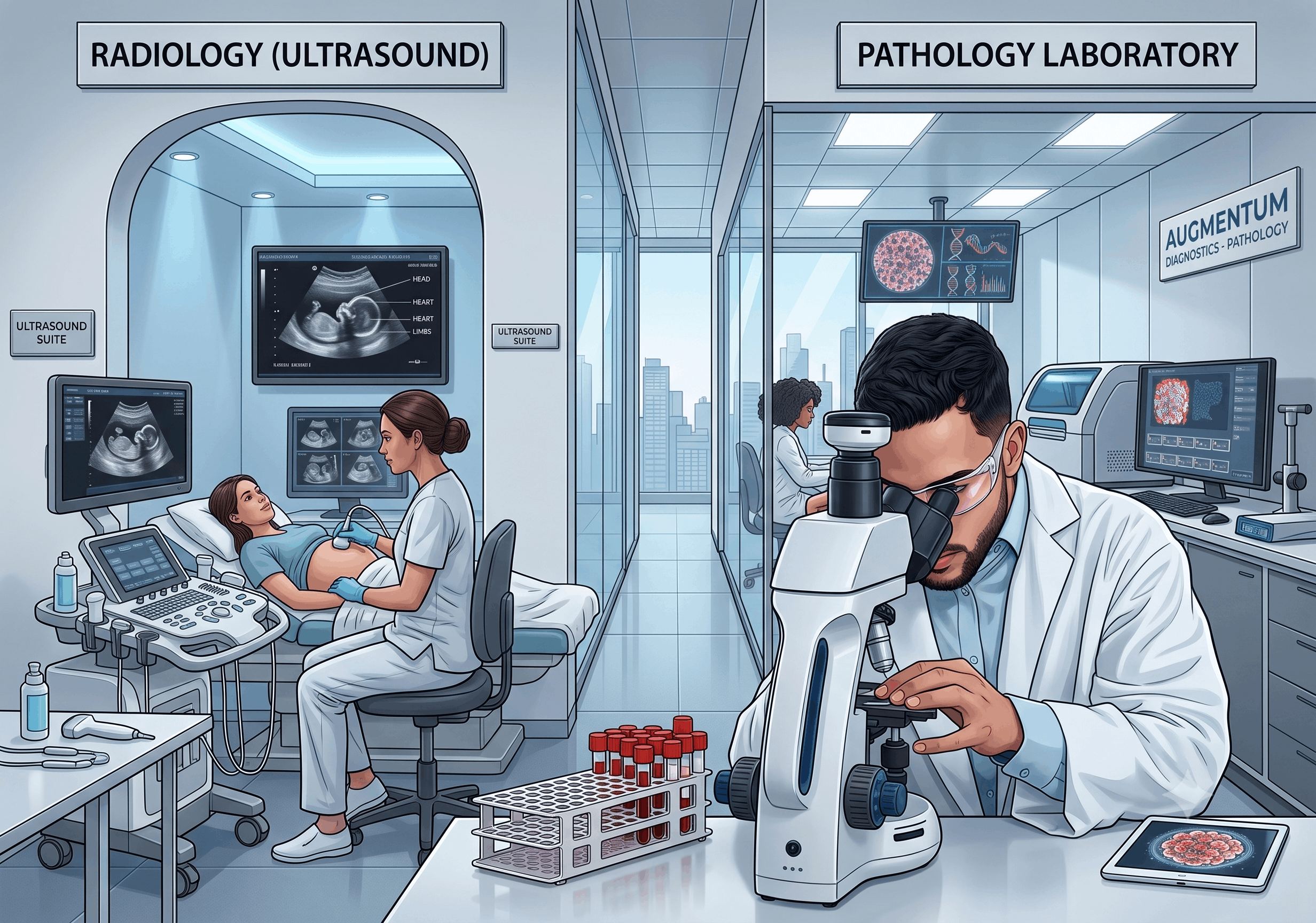
Choose a diagnostic center by matching its documented capabilities to your prescription, not by selecting the package with the most parameters or the newest scanner. You will be able to check accreditation, specimen handling, patient preparation, report quality, turnaround promises, and imaging safety before you book.
Key takeaways
- Match the centre’s test name and specimen type to the prescription.
- Ask how samples are labelled, stored, transported, and rejected.
- Confirm fasting, medication, identification, and consent requirements before booking.
- Compare report access, radiologist review, turnaround time, and image files.
Match the test menu to the prescription
Start with the prescription, not the centre’s health-checkup package. Copy the clinician’s exact wording and ask the centre to confirm that its diagnostic test menu contains the same investigation, not a similarly named substitute.
Before booking, send a photo of the prescription and get confirmation of:
- The exact test name, specimen type, and method, such as serum versus urine or PCR versus culture.
- For imaging, the body region and protocol, such as CT chest versus high-resolution CT chest, or MRI with contrast versus without contrast.
- Any clinical information required for interpretation, including the reason for testing and relevant prior findings.
- Whether the sample is processed on site or referred, and which laboratory will issue the report.
Do not treat a health-checkup package as prescription matching. A large bundle of screening tests can produce false positives and incidental findings, leading to repeat testing or invasive procedures without proven benefit. Match screening tests to your clinician’s recommendation and your personal risk, not to the number of parameters advertised.
If a centre gives generic fasting instructions, check them against the ordering clinician’s directions; fasting is test-specific, and a package rule does not override the prescription. For imaging, ask who will interpret the study and whether the centre can compare it with earlier images.
Check accreditation, specimen handling, and collection controls
Trust an accredited laboratory only after checking that its accreditation covers the exact test and collection site you will use. ISO 15189 accreditation addresses medical-laboratory quality and competence, but it does not automatically cover every test, home-collection service, branch, or imaging modality.
Ask to see the current certificate and scope, and confirm that your report names the laboratory that performed the analysis.
Before booking, ask these questions:
- Is this on-site testing, or will the specimen go to a reference laboratory testing facility? Ask where analysis occurs, the expected transport time, and the temperature range required for your test.
- Will the collector verify your name and date of birth against an identification document before collection?
- Will tubes receive barcodes or labels in your presence, showing your identifiers and the collection date and time?
- How will the center keep the specimen at the required temperature and within its stability limit during transport?
- What happens if the sample is hemolysed, contaminated, underfilled, in the wrong tube, misidentified, or delayed? Confirm the rejection and recollection process.
These controls matter because wrong-patient specimens, inadequate volume, haemolysis, contamination, and transport delays occur before analysis and can distort a valid test. For home collection, a visiting phlebotomist is not enough: you need documented identification, labelling, collection time, storage, and handover controls.
A center that cannot explain those steps has not given you evidence that the result will remain reliable.
Confirm preparation and patient-identification procedures before booking
Ask the center for written preparation instructions before booking. Confirm whether your order requires a fasting blood test, how many hours without food are needed, and whether water before blood test is allowed. Ask which prescribed medicines you should take, delay, or bring with you; do not stop treatment without your clinician’s instruction.
Disclose every vitamin and supplement, especially high-dose biotin, because biotin interference can produce falsely high or falsely low immunoassay results. Ask the laboratory or clinician whether you must stop it and for how long.
Use these questions to check the collection process:
1. “How will you identify me?” The collector should check two identifiers, such as your full name and date of birth, against the request and identification document, then label tubes in your presence.
2. “What will you record?” Confirm that the record includes collection date and time, fasting status, relevant medicines, and the collector’s details. Barcodes should match the request and tubes.
3. “What happens if something is wrong?” Ask how the center corrects a spelling or date-of-birth error before collection, rejects a wrong or haemolysed tube, and arranges recollection. Do not accept a handwritten alteration without a documented correction.
4. “How is home sample collection controlled?” Ask whether temperature is maintained and whether transport reaches the testing laboratory within the specimen’s stability limit. A home visit alone does not prove reliable handling.
Compare reports, result communication, and turnaround times
A quoted turnaround time is useful only when you know when the clock starts. Ask whether it runs from home collection, phlebotomy, or specimen receipt at the testing laboratory, and when the result is released to you.




Comments (0)
No comments yet. Be the first to comment!
Leave a Comment